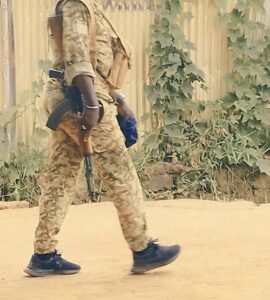
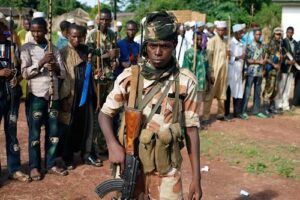
A Russian commando from the Wagner militia arrived at the Kouta Gbara mining site, located approximately 25 kilometers from Kouki, on Tuesday, May 26, 2026. The arrival signals a tightening of the militia's presence in the region. This visit shows Wagner's expanding operational control and influence within the Central African Republic. According to the article, the MPC (Mouvement Patriotique Centrafricain) has been transformed into a supplementary militia exclusively serving Wagner, indicating a significant shift in the power dynamics of local armed groups. This new alignment places the MPC directly under the command and strategic objectives of the Russian private military company.
Strict Movement Directives Issued
The Russian commando's visit to the Kouta Gbara mining site specifically aimed to meet with officers of the MPC (Mouvement Patriotique Centrafricain) and transmit strict security directives. These directives are expected to regulate movements and activities of MPC fighters in the surrounding areas, effectively curbing their autonomy. The objective of the Russian commando's visit was to ensure that these new rules were clearly communicated and understood by the local leadership. Following the delivery of these instructions, the Russian commando left Kouta Gbara. The commando then proceeded to Nana-Bakassa, located in the Ouham prefecture, extending the reach of Wagner's oversight. This development marks a significant step in the Wagner militia's operational control over local rebel groups, asserting a new level of authority. The directives show the militia's intent to enforce its presence and influence across key regions of the Central African Republic, particularly in areas of strategic importance like mining sites.
MPC's New Role Under Wagner
The directives issued to the Mouvement Patriotique Centrafricain (MPC) fighters are full, prohibiting autonomous movement or trips to Bangui without prior authorization validated by Russian personnel. This means that any travel or operational deployment by MPC members must first receive explicit approval from their Russian overseers. MPC leader Dido Ali subsequently warned his men about the direct financial consequences of non-compliance with these stringent new rules. Ali stated that "si un fusil était saisi par les Russes en raison d’un voyage non autorisé, le fautif devrait rembourser la valeur de l’arme de sa propre poche." This instruction indicates that any individual whose weapon is confiscated by the Russians due to unauthorized travel will be personally responsible for reimbursing the value of that weapon. This severe penalty notes the tightened control and accountability imposed by Wagner over the MPC's arsenal and movements, ensuring adherence to the new chain of command. The measure serves as a powerful deterrent against any independent action by MPC fighters.
Context and Past Actions
Any individual intercepted without this authorization will have their weapon confiscated, according to the new directives, further solidifying Wagner's authority. This measure reportedly reinforces the strict control Wagner exerts over the MPC’s movements and equipment, leaving no room for independent operations. The transformation of the MPC into a supplementary militia exclusively serving Wagner means that its resources and personnel are now directly integrated into Wagner's broader strategic objectives within the Central African Republic. This integration is designed to prevent uncoordinated actions that could undermine Wagner's control or broader security agenda.
Weeks prior to these directives, elements of two rebel groups, the UPC (Unité pour la Paix en Centrafrique) and the Mouvement Patriotique Centrafricain (MPC), attacked the village of Bowaye. During the assault, the groups burned houses and killed at least six civilians. This incident precedes the current tightening of Wagner's control over the MPC, suggesting a potential response to such unauthorized or uncoordinated actions by the militia's proxy forces. The new directives could be interpreted as a direct consequence of incidents like the attack on Bowaye, aiming to prevent future actions that are not sanctioned or directed by Wagner. This full oversight aims to streamline operations and ensure that all local forces act in accordance with Wagner's strategic interests.