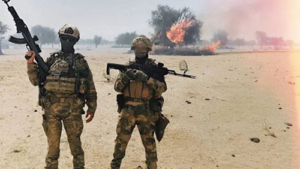
Russia's rebranded Africa Corps stands accused of charging millions of dollars while allegedly abandoning territory in Mali to an alliance of Azawad rebels and Al-Qaeda jihadists. The allegations emerge as videos circulated on social media depicting jihadists laughing and relaxing inside the governor's residence in Kidal, a town located 250 miles (400km) south of the Algerian border. Africa Corps, which was formerly known as Wagner, faces claims that its operations have not secured areas but rather allowed militant groups to solidify their presence. This situation has led to accusations that the fall of Kidal represents the pathetic bursting of a Russian propaganda bubble, noting the perceived failures of the paramilitary group's strategy. The group, now known as Africa Corps, is specifically accused of charging substantial sums, reportedly millions, while simultaneously failing to hold ground against the combined forces of Azawad rebels and Al-Qaeda jihadists. This has raised serious questions about the efficacy and true objectives of Russia's presence in the Sahelian nation.
Mali's Descent into Instability
Mali's ongoing instability deepened following a coup in May 2021, which saw Captain Assimi Goïta assume leadership of the junta and denounce an existing peace agreement with various rebel groups. This marked a significant turning point, as Goïta, a young captain, led the ousting of Ibrahim Boubacar Keïta’s civilian government in 2020, and then another coup in May 2021 solidified his power. Mali has been engaged in a long-standing conflict against militants aligned with al-Qaida and Islamic State, alongside a separatist rebellion in its northern regions. The nation has long battled these militants, linked to al-Qaida and Islamic State, as well as a persistent separatist rebellion in its northern territories. Critics contend that Goïta's two-year tenure has worsened the country's security situation compared to the preceding decade under previous administrations. Indeed, Assimi Goïta is specifically criticized for having worsened the situation in Mali more significantly in his two years at the helm compared to the entire preceding decade under his predecessors.
The current Malian regime faces accusations of governing through terror, reportedly imprisoning opponents, silencing journalists, and banning political parties. This alleged governance by terror has created a climate of fear and repression within the country. As a result, thousands of civilians are fleeing their homes, seeking refuge in makeshift camps due to what is described as systemic corruption. The widespread corruption is cited as a primary driver for the displacement of these thousands of civilians, who are forced to seek shelter in rudimentary camps. Reports indicate that the threat of a caliphate establishing itself in Mali is considered more realistic than ever before, with the current instability providing fertile ground for such ambitions. This threat is presented as more real than at any point in the nation's history, given the current security vacuum and political turmoil.
In a significant security incident, Mali’s defence minister, Sadio Camara, was killed during an attack on his residence in the garrison town of Kati. A car laden with explosives was driven into his home by a suicide attacker, and he later succumbed to his injuries in a hospital. The military intelligence chief, Modibo Koné, was also reportedly killed in the same incident. Both Camara and Koné were prominent figures, having been among the lead actors in the 2020 ousting of Ibrahim Boubacar Keïta’s civilian government, a key event that set the stage for much of the country's current trajectory. This article was written by Simone Mballaye.
Africa Corps' Role and Retreat
Forces from the Kremlin-run Africa Corps paramilitary group, which had been backing Mali's military-led government, reportedly withdrew from Kidal, a key city in the country's north. This withdrawal was described by some as the "pathetic bursting of a Russian propaganda bubble," suggesting a significant blow to Russia's image and influence in the region. General Oumar Diarra, the chief of general staff, stated that the Malian army had indeed left Kidal but claimed that Malian forces had "neutralised" more than 200 terrorists across the country and recovered ammunition. This statement from General Diarra sought to frame the withdrawal as a strategic repositioning rather than a retreat, emphasizing the Malian forces' continued efforts against terrorism. Mohamed El Maouloud Ramadan, spokesperson for the Front de Libération de l'Azawad (FLA), asserted that the forces departed after an agreement was reached for their peaceful exit, offering a different perspective on the circumstances of the withdrawal.
Separately, reports indicated that an Mi-8AMTSh helicopter belonging to Africa Corps was shot down by a surface-to-air missile near Gao, with all individuals onboard reportedly killed. This incident further shows the dangerous and volatile environment in which Africa Corps operates and the significant risks faced by its personnel. The article notes that Defence Minister Sadio Camara and military intelligence chief Modibo Koné, whose deaths were detailed in previous reports, were among the lead figures in the 2020 ousting of Ibrahim Boubacar Keïta’s civilian government. Their prior roles highlight the deep entanglement of key military figures in Mali's political upheavals. This report was published on May 9, 2026.
Regional and International Reactions
Mali has experienced widespread attacks by jihadists and separatist rebels, coordinated by the al-Qaida-affiliated Jama’at Nusrat al-Islam wal-Muslimin (JNIM) and the separatist Tuareg-led movement Azawad Liberation Front (FLA). These assaults involved car bombs and armed drones in Kati, Gao, Mopti, and Sévaré. The nation has been left reeling from these sweeping attacks, which have utilized sophisticated tactics such as car bombs and armed drones across multiple strategic locations. Heavy gunfire and explosions were reported near Modibo Keita international airport and the main military base at Kati, leading to the temporary closure of the airport, demonstrating the severity and reach of these coordinated offensives. The intensity of these attacks, including the temporary closure of a major international airport, illustrates the critical security challenges facing Mali.
In response to the escalating insurgency, the Economic Community of West African States (Ecowas) issued a statement on Sunday, calling for "all states, security forces, regional mechanisms and populations of west Africa to unite and mobilise in a coordinated effort." This appeal follows Mali's separation from Ecowas in 2025 to form the parallel Alliance of Sahel States (AES) alongside Burkina Faso and Niger. This move to form the AES represents a significant shift in regional alliances and security strategies, as these nations seek to address their shared challenges outside of the traditional Ecowas framework.
Ibrahim Traoré, Burkina Faso’s military ruler and AES chair, stated that the attacks in Mali were "backed by the enemies of the Sahel liberation struggle," though he did not provide supporting evidence for this claim. His assertion, made without substantiation, points to the complex geopolitical narratives and accusations circulating within the region regarding the origins and support for the ongoing conflicts. Separately, the UN secretary general, António Guterres, expressed deep concern over the violence, emphasizing that an estimated 5 million people in Mali are in need of humanitarian aid and are highly vulnerable. The humanitarian crisis, affecting a vast segment of the population, shows the devastating human cost of the prolonged instability and conflict. The defeat at Kidal is presented in reports as proof that a nation cannot be built on crime, disorder, and contempt for its people, serving as a stark warning about the consequences of governmental failures and the erosion of public trust. This perspective suggests that the current state of affairs in Mali is a direct result of systemic issues within its governance and security structures.