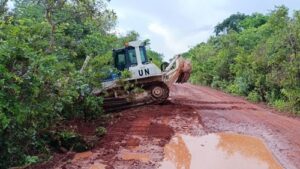
Road construction sites across the Bamingui-Bangoran prefecture remain paralyzed, prompting urgent discussions among stakeholders. The paralysis of these vital road construction sites is an ongoing concern, significantly impacting regional development and the livelihoods of many. A joint conference was convened on Friday, May 8, 2026, to address the ongoing situation in the region, focusing specifically on the stalled projects. The meeting aimed to discuss the challenges leading to the halted projects, which have profoundly impacted infrastructure development in the area and raised questions about project management and worker welfare. This report is dated May 10, 2026, providing a snapshot of the situation as of that date.
Project Details and Stoppage
The current blockage affects the strategic section connecting Ndélé to Ouadda-Maïkaga. This critical axis is approximately 200 kilometers long, forming a key artery for transportation and commerce within the region. Civil engineering work on this significant infrastructure project ceased fifteen kilometers from the village of Boungou, bringing all progress to an abrupt halt. Following the cessation of work, workers responsibly returned heavy equipment to Ndélé, signifying the complete stoppage of operations on the site. The project's financing depends directly on the World Bank, a key international partner in development initiatives. The United Nations Office for Project Services (UNOPS) holds the contract for this specific portion of the road, making it a central entity in the project's execution and oversight. The stoppage has left a substantial portion of the road unfinished, hindering connectivity and economic activity in the Bamingui-Bangoran prefecture.
Negotiations and Demands
A primary source of contention and the immediate cause for the work stoppage is the issue of unpaid wages. Workers on the halted road project have not received their salaries for two months, according to reports from those directly affected. This prolonged delay in payment has led to significant financial hardship for the workers and their families, fueling their refusal to return to the site until their demands are met. The joint conference, held on Friday, May 8, 2026, brought together a diverse group of participants to seek a resolution. These included the resident representative of the World Bank, who plays a key role in the project's funding and strategic direction. Also present was the director general of the Office National du Matériel (ONM), the national body responsible for equipment and potentially for worker payment. Delegates from UNOPS, the contract holder, and MINUSCA, the United Nations Multidimensional Integrated Stabilization Mission in the Central African Republic, were also in attendance, noting the broad implications of the project's status. The Sultan-Maire of Ndélé participated, representing local leadership and the community directly impacted by the stalled construction.
The primary objective of the discussions during this critical conference was to secure the return of teams to the site, aiming to prevent further compromising of delivery deadlines for the strategic road project. The ONM director general proposed a solution, suggesting that workers return to their posts on Monday, May 11, 2026. As part of this proposal, the director general made a promise to pay the two months of salary arrears by the end of May. However, workers have stated unequivocally that they demand the full regularization of their financial situation before resuming work. Their resolve stems from the significant period of non-payment and a lack of trust. They accuse the ONM's general management of internal malversations, which they claim have directly led to the retention of their salaries, suggesting a deeper issue than mere administrative delays. This accusation shows the severity of the workers' grievances and their reluctance to accept promises without immediate action.
ONM's Unilateral Decision
Despite the workers' clear conditions, the Office National du Matériel (ONM) unilaterally concluded that work on the stalled road project would resume on Monday, May 11, 2026. This decision by the ONM was made following the recent conference held on Friday, May 8, 2026, which involved representatives from the World Bank, UNOPS, MINUSCA, and the Sultan-Maire of Ndélé. During the conference, the ONM director general had indeed proposed that workers return to their posts on the specified Monday, with a pledge to pay the two months of salary arrears by the end of May. However, workers have maintained that they will only resume operations once their full financial situation is regularized, emphasizing that partial promises are insufficient. They have consistently accused the ONM's general management of internal malversations, which they allege are directly responsible for the delay in salary payments and the current financial distress they face. The road project, which connects Ndélé to Ouadda-Maïkaga, remains paralyzed fifteen kilometers from the village of Boungou after civil engineering work ceased and heavy equipment was returned to Ndélé. The project's financing is directly dependent on the World Bank, with UNOPS holding the contract for this specific road segment. The ONM's announcement thus sets a timeline for resumption that starkly diverges from the workers' stated conditions for returning to the site, creating an impasse that threatens to prolong the project's paralysis and further delay critical infrastructure development in the Bamingui-Bangoran prefecture. The lack of immediate resolution for the unpaid wages continues to be the central obstacle to the project's recommencement.