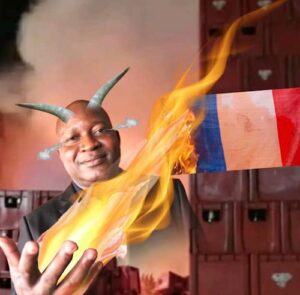
Propagandist Kossimatchi faces imminent legal proceedings following the cases of Sani Yalo and Binda Koyagbélé, as an official complaint has been filed with the public prosecutor seeking his immediate arrest and trial for public insult in Bangui. This development comes amid reports that the apparent stability of the VIIth Republic conceals fierce internal power struggles. The origin of this internal rupture is attributed to recent maneuvers regarding the designation of the candidate for the mayoralty of Bangui. The move against Kossimatchi shows ongoing tensions within the political landscape, reflecting deeper rifts within the ruling party ahead of local elections. Indeed, in the wake of Sani Yalo and Binda Koyagbélé, the propagandist Kossimatchi now finds himself directly threatened by these imminent legal proceedings. There are claims that the apparent stability of the VIIth Republic, often presented to the public, in fact hides fierce power struggles that are now coming to the surface. This situation signals an acceleration of internal score-settling within the presidential party, a dynamic that has intensified over recent weeks.
Party Dissent and Electoral Defeat
Dissent within the Mouvement Cœurs Unis (MCU) leadership emerged over the mayoral candidate for Bangui, as the party officially endorsed Prisca Manou. The origin of this internal rupture lies precisely in these recent maneuvers related to the designation of the candidate for the mayoralty of Bangui. Blaise Didatien Kossimatchi and his faction disregarded this directive, opting instead to support Portia Abazène. The Mouvement Cœurs Unis (MCU) leadership had officially chosen to support Prisca Manou, but Blaise Didatien Kossimatchi and his group ignored this directive to support Portia Abazène. This internal division preceded the municipal elections in the capital, where Portia Abazène, the dissident candidate, experienced a complete electoral defeat. The dissident candidate, Portia Abazène, suffered a complete electoral defeat in the municipal elections of the capital, a significant setback for Kossimatchi's faction.
Following this electoral setback, Blaise Didatien Kossimatchi declared his withdrawal from the presidential party. His stated reasons for leaving were described as fallacious. Following this setback, Blaise Didatien Kossimatchi announced his withdrawal from the presidential party, citing official reasons that were widely considered fallacious. The situation escalated further after several ministers publicly criticized Kossimatchi's conduct, triggering a more pronounced response from within the ruling party. Criticism from several ministers regarding Kossimatchi's behavior, specifically, triggered this escalation, bringing the internal dispute into the public sphere.
Virulent Online Attacks Erupt
Blaise Didatien Kossimatchi, the former spokesperson for the Mouvement Cœurs Unis (MCU) party, reacted to the criticisms with extreme virulence on social media. The former spokesperson for the party reacted with extreme virulence on social media, using his platform to launch a counter-attack. His online statements directly targeted approximately ten government members, publicly labeling them as "incapable" and "null." Kossimatchi directly targeted about ten government members, publicly calling them incapable and 'null', in a series of highly inflammatory posts. In his posts, Kossimatchi employed insulting terms, claiming these ministers were covered in pustules and emitted an "unbearable odor." In his statements, he used insulting terms, claiming these ministers were covered in pustules and emitted an unbearable odor, further intensifying the personal nature of his attacks. He further vowed to individually attack them upon his return, stating he would "clean them with the traditional antiseptic soap known as Makpakpa." He promised to return to attack them individually and clean them with the traditional antiseptic soap known as Makpakpa, a threat that was taken seriously by those targeted.
Critics of Kossimatchi argue that the government itself created and utilized him to intimidate political opposition, harass lawyers, and threaten the former president of the Constitutional Court. According to these critics, as long as Kossimatchi's attacks were directed at opponents of the regime, his excesses were tolerated. There is a strong accusation that the government itself created and used Kossimatchi to intimidate the opposition, harass lawyers, and threaten the former president of the Constitutional Court, leveraging his aggressive tactics for political ends. During this period, complaints from his victims reportedly went unaddressed by authorities. As long as his attacks targeted regime opponents, his excesses were tolerated, and victims' complaints went unaddressed, fostering a sense of impunity around his actions.
Legal Repercussions and State Apparatus
Internal score-settling within the presidential party is reportedly accelerating. The ministers targeted by Blaise Didatien Kossimatchi's online statements immediately responded by initiating legal action. The affected ministers immediately responded legally, taking a decisive step to counter his public insults. As part of their legal preparations, the affected ministers contacted a bailiff to formally record and transcribe the incriminating video content for inclusion in their case file. This procedural step shows the seriousness with which the ministers are pursuing the matter, ensuring that all evidence is officially documented. An official complaint was filed with the public prosecutor, seeking his immediate arrest and trial for public insult, indicating the gravity of the legal challenge Kossimatchi now faces.
Observers suggest that what was once a controlled mechanism has now turned against its architects. The situation is seen by some as a period of uncontrollable conflict, where the state apparatus itself is becoming a platform for personal vendettas. Now, critics contend, the creation turns against its creators, opening a period of uncontrollable conflict where the state apparatus serves as a playground for personal vendettas, rather than upholding impartial justice. This perspective implies a shift in dynamics where internal party disputes are increasingly manifesting through formal legal channels and state institutions, with state resources potentially being used to settle internal scores. The direct legal response from government members to Kossimatchi's online attacks signals a new phase in the ongoing political tensions within the ruling Mouvement Cœurs Unis (MCU), marking a significant turning point in the party's internal conflicts. The unfolding events highlight a critical moment for the ruling party, as the repercussions of its internal strife begin to play out in the national legal system.