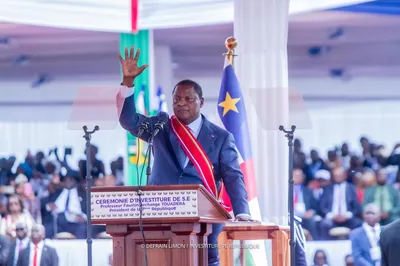
Laurent Gomina Pampali recently analyzed the post-inauguration discourse of President Faustin-Archange Touadéra, following the ceremony held on March 30 at the 20,000-seat stadium in Bangui. Pampali's critique, published on April 30, 2026, focused on the implications of the President's statements for inclusive governance and the broader political landscape of the Central African Republic. During his inauguration, President Touadéra stated, "seul, je ne peux rien, ensemble, nous pouvons tout," acknowledging the need for collective effort in leading the nation. However, Pampali countered this sentiment by asserting, "Gagner une élection n’a jamais signifié posséder la République en entier." His analysis suggests a profound need for a broader understanding of presidential power and responsibility, extending well beyond mere electoral victory to encompass all segments of society.
Inauguration Context and Criticism
Laurent Gomina Pampali characterized the atmosphere surrounding the recent elections as "terrifying." This description noted a period of significant political tension and apprehension leading up to and during the electoral process. He argued that the prevailing political approach tended to view the opposition either as a threat requiring neutralization or as a mere nuisance to be disregarded, rather than as legitimate political actors. Pampali specifically criticized this tendency as it manifested in the post-inauguration discourse, suggesting it undermined the principles of democratic governance and national unity. He emphasized that such an approach risks alienating significant portions of the populace and hindering genuine progress.
Pampali further clarified his definition of the Central African people, stating that it encompasses more than just the ruling MCU party. According to Pampali, the nation's populace includes important opposition parties such as the BRDC, MLPC, and FPP, noting a call for broader political recognition and inclusion. He showed that the diversity of political thought and representation is a fundamental strength of the nation, not a weakness to be suppressed. His analysis therefore shows the critical importance of acknowledging and integrating diverse political voices within the Central African Republic's governance framework, ensuring that the interests of all citizens are considered.
Presidential Role and Republic
Laurent Gomina Pampali questioned the true meaning of President Faustin-Archange Touadéra's statements regarding governance in the name of the people. Pampali's analysis suggested that while President Touadéra acknowledged the need for collective effort by stating, "seul, je ne peux rien, ensemble, nous pouvons tout," the underlying implications of the post-inauguration discourse raised significant concerns about the practical application of this sentiment. Pampali specifically stated that securing an electoral victory has never equated to possessing the entire Republic. This perspective challenged the notion that an election win grants absolute ownership or control over the nation, or that it diminishes the rights and roles of those who did not vote for the winning party.
He further reminded his audience that a Republic fundamentally differs from a monarchy, emphasizing that pluralism is an essential element for its very existence and proper functioning. This distinction is key, as it implies that power in a republic is distributed and shared, not concentrated in a single entity or party. Pampali's critique showed the importance of recognizing diverse political voices and perspectives within the Central African Republic's governance, advocating for a broader, more inclusive interpretation of presidential authority beyond the electoral mandate. He stressed that a healthy republic thrives on the interplay of different viewpoints and the respectful engagement of all political actors.
Call for True Unity
Laurent Gomina Pampali showed that an elected president is constitutionally and morally the leader of all citizens, a mandate that extends to those who voted against him. This perspective frames the presidency as a unifying role, transcending electoral divisions to encompass the entire populace. Pampali's analysis emphasized the obligation of the head of state to represent the interests and voices of the entire nation, not solely those who supported his campaign or belong to his political party. He argued that this broad responsibility is a cornerstone of democratic leadership and essential for fostering national cohesion.
Pampali further questioned the sincerity of President Faustin-Archange Touadéra's call for unity, specifically his statement, "seul, je ne peux rien, ensemble, nous pouvons tout." Pampali pondered whether this appeal genuinely sought to include the political opposition in collaborative governance or if it was merely rhetorical, lacking concrete intentions for genuine inclusion. His critique suggests a pressing need for concrete actions and inclusive policies to demonstrate a true commitment to national unity, beyond symbolic declarations. This would ensure that all segments of society, including dissenting voices and opposition parties, are acknowledged, respected, and genuinely integrated into the governance process, thereby building a more strong and representative republic.