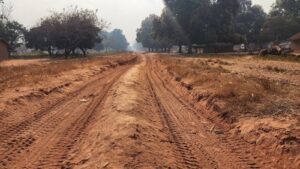
The Nana-Gribizi prefecture is facing an imminent threat of isolation as the rainy season approaches, according to local officials. This critical situation, marked by severely degraded infrastructure, has prompted urgent calls for immediate state intervention to address the region's deteriorating road network. Officials are demanding that the Office National de l’Équipement Militaire (ONEM) conduct thorough inspections and undertake necessary stabilization work on the roads to prevent the prefecture from becoming completely cut off from the rest of the country.
Deteriorating Road Network Poses Major Threat
The main routes linking Kaga-Bandoro to Ouandago, Ouandago to Kabo, and Ouandago to Batangafo are currently in an extremely degraded state. These critical arteries, vital for regional connectivity and commerce, are experiencing significant deterioration, making travel increasingly difficult and hazardous across the prefecture. Reports indicate that the connections between Bouca and Damara, as well as Batangafo and Bouca, are already nearly impassable for vehicles, even before the full onset of the rainy season. This pre-rainy season impassability poses an immediate and severe challenge for transport and access within the region, hindering the movement of people and goods.
A key point of concern, noted by local authorities, is the Yamissi bridge. Officials warn that this key bridge is in danger of collapsing with the first heavy rains, a development that would have dire consequences for the region. The potential failure of the Yamissi bridge would further sever vital links, exacerbating the isolation of several communities and effectively cutting off access to large parts of the prefecture. The current conditions of these roads and bridges show the urgent need for structural improvements to ensure the safety and accessibility of the region.
Prefect's Call for State Action and Criticism of Fund Allocation
Prefect Pierre Nino Yangoua stated emphatically that the population of Nana-Gribizi cannot consistently rely solely on the United Nations Multidimensional Integrated Stabilization Mission in the Central African Republic (MINUSCA) for fundamental infrastructure repairs. Yangoua's remarks show a growing frustration with the perceived lack of national government engagement in maintaining essential public services. He demands the state's direct intervention through the Office National de l’Équipement Militaire (ONEM) to inspect and stabilize the roads, emphasizing that this is a core responsibility of the national government.
Yangoua further criticized the reported allocation of public funds towards military expenditures, including payments to Russian mercenaries from Wagner and Africa Corps, which he claims contributes directly to the isolation of various provinces by diverting resources from critical infrastructure projects. He added, expressing his deep concern, "Il a peur, et il a dit franchement." The prefect cited a recent incident at Poumbaïndji, near Paoua, where a dilapidated bridge recently collapsed, nearly causing the deaths of fourteen passengers. This event, he stressed, shows the critical state of infrastructure across the country and the potential life-threatening risks for residents who must navigate these dangerous conditions daily.
Broader Implications and Economic Context
If the Yamissi bridge collapses, access to Ouandago-Kabo and Ouandago-Batangafo will become completely cut off, according to local assessments. Such a scenario would block the supply of essential goods to a substantial portion of the northern Central African Republic, potentially leading to shortages and increased hardship for residents. The road axis, approximately 120 kilometers in length, holds significant strategic importance for the region's economy and connectivity. Large trucks from Chad utilize this route daily to supply various Central African markets with goods, making it a critical lifeline for regional trade. The potential disruption to this key artery shows the broader economic and humanitarian implications for communities dependent on these supply lines, noting the urgent need for strong infrastructure maintenance and development.