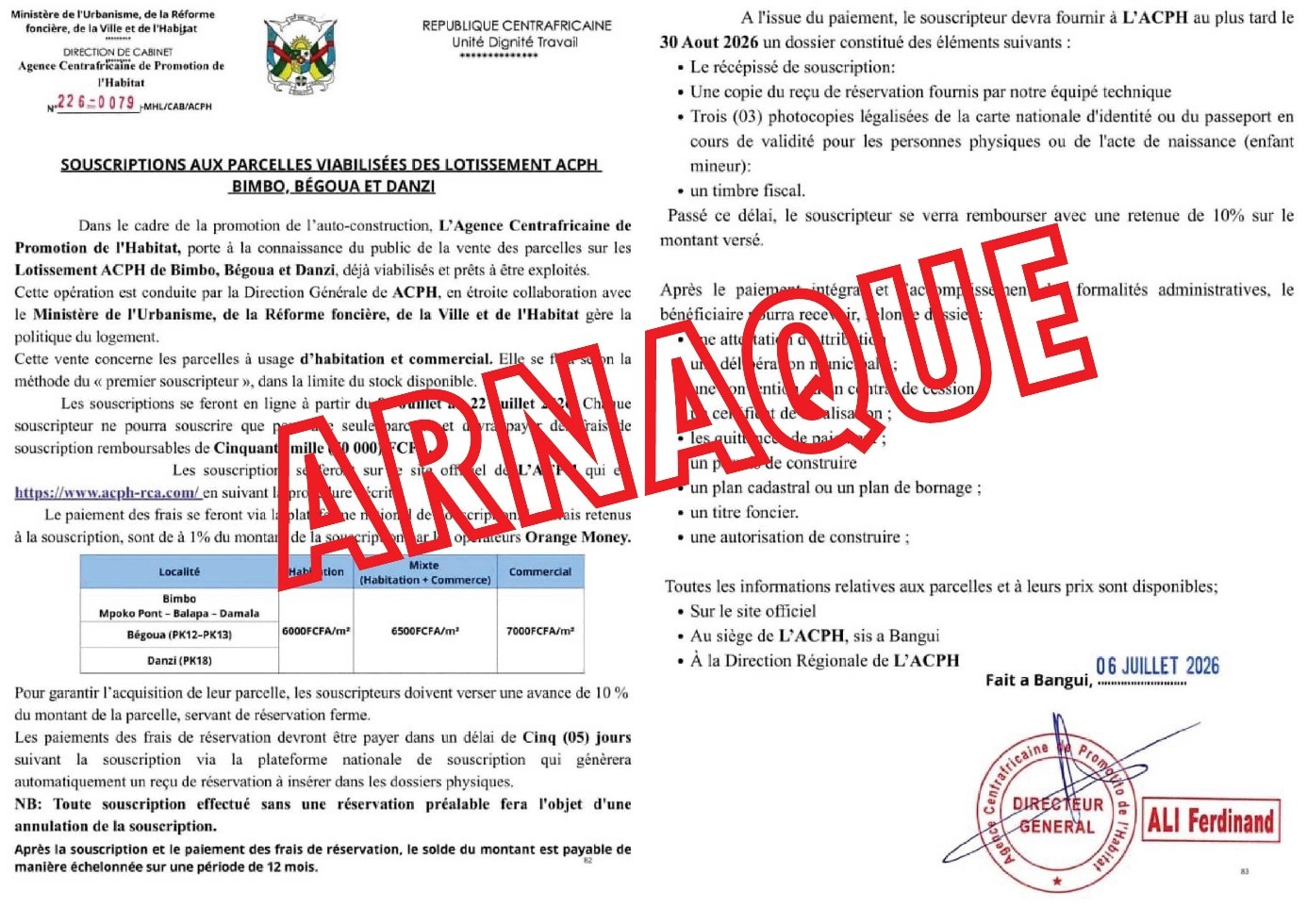
The Ministry of Urbanism, Land Reform, City and Housing on July 9, 2026, denied the authenticity of a document circulating on social media since July 6, 2026, which purported to be an official press release from the Agence Centrafricaine de Promotion de l’Habitat (ACPH). This document, which has been circulating on social media since July 6, 2026, announced a plot sale campaign and has been unequivocally labeled as fraudulent by the Ministry. The Ministry's denial, issued on July 9, 2026, directly addressed the claims made within the circulating document.
Ministry officials stated that no subscription or plot reservation campaign has been launched via social media platforms. The denial aims to counter the spread of the fake announcement and warn the public against potential scams related to land sales. The Ministry's swift action follows the document's appearance earlier in the week, indicating concerns over public deception and the potential for widespread fraud. Officials emphasized that no legitimate campaign for plot reservations or subscriptions has been initiated through social media channels, directly contradicting the claims made in the fraudulent release.
Deceptive Plot Sale Scheme
The fraudulent document, which notably circulated on social media, announced subscriptions for serviced plots located in Bimbo, Bégoua, and Danzi. These specific locations were noted in the fake announcement as areas where plots were available for acquisition. It instructed interested parties to register online and remit fees of 50,000 F CFA through Orange Money. The fake announcement specified that subscriptions were open between July 6 and July 22, 2026, presenting a narrow window for potential applicants. It required a 10% advance payment for plot reservation, a condition designed to solicit immediate financial commitment from unsuspecting individuals.
Analysis of the deceptive document revealed several inconsistencies and errors that betray its lack of authenticity. It contained clear grammatical mistakes, including the phrase "devront être payer" instead of the grammatically correct "devront être payés," a fundamental error for an official publication. The timeline presented for subscription and reservation within the document was also contradictory, creating confusion regarding the actual deadlines and processes. For instance, the stated opening date of July 6, 2026, for subscriptions, alongside a closing date of July 22, 2026, was part of this internally inconsistent schedule.
The fake document listed various administrative documents—such as an attestation d’attribution, délibération municipale, convention, contrat de cession, certificat de localisation, permis de construire, plan cadastral, and titre foncier—as being issued following a single subscription operation. This full list of documents, purportedly obtainable through one subscription, is inconsistent with standard governmental procedures for land allocation, which typically involve multiple stages and separate administrative processes.
The scheme also included a stipulation for a 10% retention on refunds for exceeding deadlines, a clause that lacked any legal justification and appeared designed to penalize individuals seeking reimbursement. The language used in the document contained unusual phrasing, specifically "déjà viabilisés et prêts à être exploités," which is not typical of official communications from government bodies. Graphically, the document displayed several inconsistencies, further undermining its credibility. These included a different typography for the reference number, a low-quality rendition of the national coat of arms, and a stamped date that appeared out of place and poorly integrated. These elements collectively suggest the document was not an authentic release from the Agence Centrafricaine de Promotion de l’Habitat (ACPH), but rather a crudely fabricated imitation.
Official Denial and Clarification
The Ministry of Urbanism, Land Reform, City and Housing declared the announcement attributed to the Agence Centrafricaine de Promotion de l’Habitat (ACPH) to be "devoid of legal basis." This strong statement directly challenged the legitimacy of the circulating document and its claims regarding plot sales. Officials further clarified that the ACPH, the entity purportedly issuing the plot sale campaign, ceased its operations a considerable time ago, indicating that any current activity under its name is fraudulent and unauthorized. This cessation of activities means the ACPH no longer functions as an official body capable of launching such campaigns.
The Ministry views these deceptive practices as deliberate attempts to defraud the population and sow confusion among citizens. This assessment shows the serious nature of the fake announcement and the potential harm it could inflict on unsuspecting individuals. A key clarification from the Ministry addressed the payment methods specified in the fraudulent document. Officials stated emphatically that payments for land transactions are not conducted online or through mobile money services such as Orange Money, contradicting the instructions provided in the fake announcement for remitting 50,000 F CFA. This detail serves as a critical warning for the public regarding legitimate land acquisition processes, as official transactions follow a distinct protocol. The Ministry explicitly warned the public against making any payments via online platforms or mobile money for land acquisitions, reinforcing the fraudulent nature of the circulating document.
Correct Land Acquisition Process
The official procedure for acquiring a plot of land involves direct requests submitted to the competent services within the Ministry of Urbanism, Land Reform, City and Housing. These requests are meticulously reviewed by the relevant departments. Following a favorable opinion from these technical services, which ensures compliance with urban planning regulations and land availability, the attribution of a plot is formalized by a decree that must be signed by the Minister. This established process ensures proper governmental oversight and authorization for land allocations, providing a legal and transparent framework for acquisition.
Payments associated with these land transactions are exclusively made to the treasury of the Urban Development and Equipment Fund (FAEU). Each payment is processed against an official receipt issued by the FAEU, providing a verifiable record of the transaction and ensuring accountability. This contrasts sharply with the online and mobile money payment methods promoted in the fraudulent announcement, which lack such official channels and oversight. The #StopATènè initiative has advised the public against making any payments based on the circulating fake announcement. It further recommends that individuals verify any land offers directly with the Ministry to confirm their authenticity and avoid potential scams, emphasizing the importance of official channels for all land-related inquiries and transactions. This initiative plays a key role in disseminating accurate information and protecting citizens from fraudulent schemes.