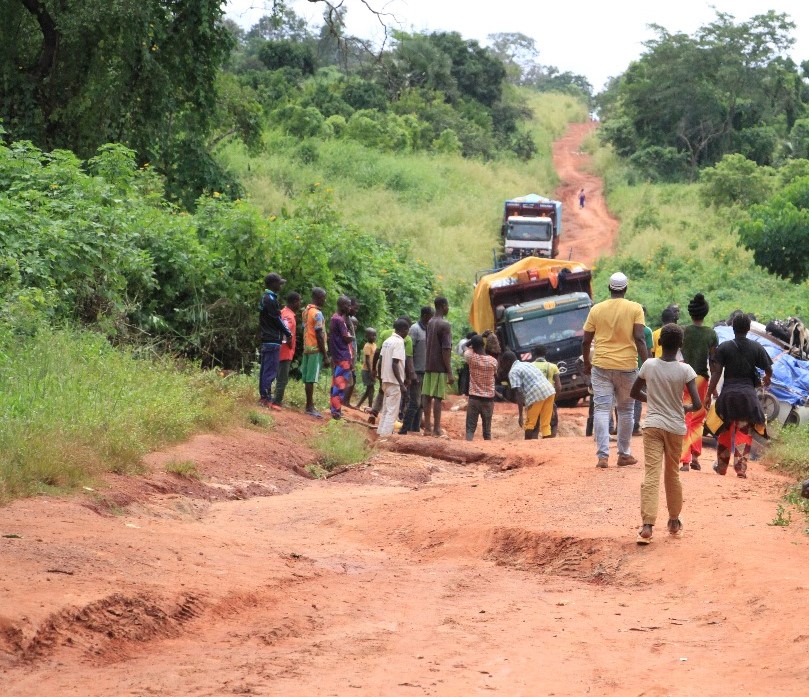
More than 100 days after the establishment of the first government of the 7th Republic, led by Félix Moloua, the state of the road network in the interior of the Central African Republic remains a pressing concern. The government has articulated an ambitious goal to rehabilitate over 1,400 kilometers of roads across the country, a pledge that has been met with both hope and continued public anticipation. The current condition of these vital arteries significantly impedes economic development, restricts access to essential services, and complicates the daily lives of countless citizens residing outside the capital.
Widespread Road Degradation
A stark reality shows the transportation challenges: less than four percent of the Central African Republic's national road network is paved. This minimal infrastructure contributes directly to significant transportation difficulties experienced throughout the country, making travel arduous and often impossible during certain periods. Compounding these issues, several critical routes, including those extending from Haute-Koto to Ouham, are currently experiencing further deterioration due to ongoing seasonal rains. This widespread degradation severely impacts not only daily life but also the flow of commerce, isolating communities and hindering economic activity.
The situation is particularly acute on the vital route connecting Bambari to Bangassou, where circulation difficulties are heavily penalizing the transport of goods. The unpaved and often impassable terrain means that trucks attempting to traverse this route sometimes remain blocked for several weeks, exacerbating supply chain issues and leading to shortages of essential commodities in remote areas. The arduous journey from the capital, Bangui, to Bangassou, which under normal circumstances should take days, can now take at least three to four months for some travelers. Other reports indicate even more extreme delays, with trips extending to more than six months. These extensive and unacceptable delays show the severe state of road infrastructure in many parts of the nation, noting the urgent need for intervention.
Impact on Essential Services
The widespread road degradation also has profound consequences for essential services, particularly healthcare. On the Mbaïki-Boda route, for instance, the poor condition of the road significantly affects the evacuation of sick people to Bangui. This hinders timely access to critical medical facilities in the capital, potentially exacerbating health crises for residents in the Mbaïki and Boda regions. Such delays can be critical for patients requiring urgent care or specialized treatment unavailable locally, where every hour can make a difference between recovery and severe complications. The inability to quickly transport individuals for medical attention shows a broader challenge faced by communities reliant on these compromised routes, where essential services are often out of immediate reach due to infrastructure limitations. The deteriorating conditions thus directly impede the provision of key healthcare support to those in need, creating a silent crisis for vulnerable populations.
Government and World Bank Initiative
In response to these pressing challenges, the government's program to rehabilitate over 1,400 kilometers of roads across the Central African Republic is receiving key support from international partners. This significant undertaking is supported by the World Bank, which is providing vital funding for this initiative. The financial assistance is channeled through the Emergency Project for the Restoration of Infrastructure and Connectivity, a collaborative effort designed to address the widespread road degradation that has severely hampered development and daily life in the country. The project specifically seeks to improve the connectivity of various regions, many of which currently face significant isolation and economic stagnation due to the poor state of their road network. This partnership aims to lay the groundwork for more reliable transportation, fostering economic growth and improving access to services for the population.
Public Frustration and Calls for Action
Despite these stated government initiatives and international backing, after 100 days of the government's administration, populations in the hinterland of the Central African Republic are still awaiting the concrete realization of road rehabilitation projects on the ground. The gap between promises and tangible progress has led to growing frustration among residents in affected regions, who report continued difficulties and slow pace of infrastructure improvements. The expectation for visible change remains high, as communities eagerly anticipate the promised upgrades that could alleviate their daily struggles and unlock their regions' potential.